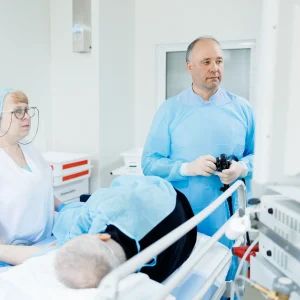
Endoscopy

Digestive endoscopy is a medical procedure used to diagnose gastrointestinal conditions. During the examination, the doctor uses a thin, flexible tube, called an endoscope, with a video camera at the end, to explore the inside of the patient's digestive tract.
During digestive endoscopy, images captured by the video system are displayed in real time on a monitor. If suspicious lesions are observed, the specialist can also perform a biopsy, i.e. the removal of tissue fragments for histopathological examination. Therapeutic procedures, such as polypectomy, can also be performed.
The Endoscopy Department of CRDM employs four endoscopists and three anesthesiologists. The department is equipped with six endoscopy video systems, 10 video gastroscopes and 10 state-of-the-art Pentax video colonoscopes, equipped with I-SCAN technology. The reprocessing and disinfection of endoscopes is carried out using three Stelco automatic machines, according to safety and infection control standards.
The following investigations are performed in the digestive endoscopy department:
- Videogastroscopy (Upper digestive endoscopy)
- Videocolonoscopy
- Endoscopic biopsy
- Endoscopic polypectomy
- Diagnosing gastrointestinal injuries
- Monitoring chronic digestive conditions
- Endoscopic procedures with sedation/anesthesia
- Evaluation of the upper and lower digestive tract
Recommendations for patient preparation:
Videogastroscopy: Пациент должен явиться на обследование в день осмотра натощак. Последний прием пищи должен состояться вечером накануне осмотра, не позднее 18:00.
Videocolonoscopy: Preparation for colonoscopy begins 3–5 days before the examination and includes following a special diet, followed by colon preparation.
5 days before the investigation
Fruits and vegetables with peels or seeds, berries, strawberries, raspberries and exotic fruits (pineapple, kiwi, tangerines, etc.) are excluded from the diet. It is also recommended to discontinue the administration of iron and/or activated charcoal preparations.
3 days before the investigation
Foods rich in fiber, such as cabbage, potatoes, radishes, peas, beans and cucumbers, as well as whole grain or bran bakery products, muesli, nuts and dried fruits are excluded. From the dairy category, kefir and yogurt with added fruit or cereals are excluded.
It is recommended to reduce meat consumption. In case of administration of insulin, aspirin, anticoagulants or anti-inflammatories, it is necessary to consult a specialist for possible adjustments of the treatment.
2 days before the investigation
It is recommended to consume small amounts of food. Clear, strained soup or broth, kefir or low-fat yogurt, boiled eggs, omelet, green or chamomile tea sweetened with honey, clear juices without pulp, and still mineral water are allowed.
1 day before the investigation
Solid foods are completely excluded. Until 09:00, consumption of a low-fat yogurt or a glass of low-fat kefir is allowed.
After this time, only clear liquids, such as plain mineral water, tea, and clear juice without pulp, are allowed. Solid foods, dairy products, meat, fish, fruits, and vegetables are prohibited.
Colon preparation
(starting at 3:00 PM on the day before the investigation)
Variant 1 – DIAGNOL / GET NOL
Dissolve 4 sachets of Diagnol/Get Nol in 4 liters of still water at room temperature (1 sachet per 1 liter of water). Stir the solution until the powder is completely dissolved and consume 150–200 ml every 15 minutes.
Option 2 – DUPHALAC (400 ml)
Dissolve 200 ml of Duphalac in 2 liters of plain water and consume the solution gradually, over 3–4 hours.
Take a break between 6:00 PM and 7:00 PM.
At 7:00 PM, dissolve another 200 ml of Duphalac in 2 liters of water and consume the solution by 9:00 PM.
In the evening, before bedtime, take 3–4 capsules of Espumisan (Simeticon) 40 mg.
Important: Duphalac is not recommended for patients with diabetes.